Toxic Tap: PFAS Contamination in America's Drinking Water
A data analysis by the O.Water team
---
Across the United States, a class of nearly indestructible chemicals is showing up in the water people drink every day. Our team analyzed EPA UCMR and state-reported PFAS monitoring results covering 273 detections across 37 states — and the findings are alarming: 60% of tested water systems contain at least one PFAS compound above the EPA's legal limits, potentially affecting more than 51 million people.
What are PFAS?
Per- and polyfluoroalkyl substances (PFAS) — often called "forever chemicals" — are synthetic compounds used for decades in firefighting foam, non-stick cookware, waterproof fabrics, and food packaging. They do not break down in the environment or in the human body, and long-term exposure has been linked to cancer, liver damage, immune suppression, and developmental harm.
Key Findings at a Glance
- 273 total PFAS detections analyzed
- 60% of tested water systems exceed EPA limits
- 51M+ people potentially affected
- 37 states covered in the analysis
Exceedance by State
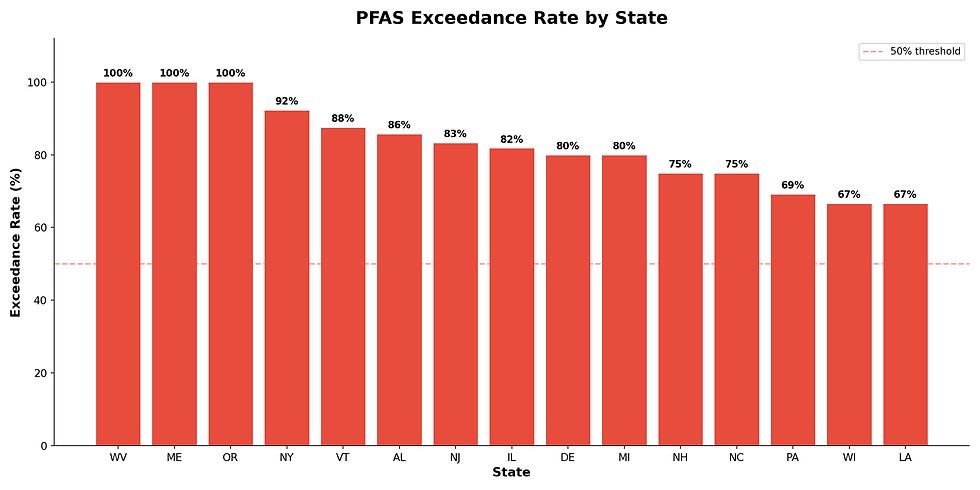
The chart above shows the PFAS exceedance rate for the 15 states with the highest rates. States shown in red have more than half of their tested water systems exceeding EPA limits. West Virginia, Maine, and Oregon top the list with 100% exceedance rates in sampled systems, indicating severe and widespread contamination.
PFOS and PFOA — the two most commonly detected compounds — have extremely low EPA limits of just 4 parts per trillion (ppt), making exceedance more likely even at trace concentrations.
Most Affected Cities

Major metropolitan areas are not immune. The chart above shows the 10 cities where the largest populations are served by water systems with at least one PFAS compound exceeding federal limits. New York City alone has 8.3 million residents potentially exposed.
Chicago stands out with 4 different PFAS compounds exceeding limits simultaneously, while Phoenix and Philadelphia each have 3–4 compounds above safe levels.
Which PFAS Compounds Were Detected?

Six regulated PFAS compounds were analyzed. PFOS and PFOA dominate detections, consistent with their historical widespread use in firefighting foam, non-stick coatings, and food packaging.
HFPO-DA (marketed as GenX) is a newer replacement compound that is increasingly detected — raising concerns that newer PFAS alternatives may not be safer than the chemicals they replaced.
The EPA's 2024 PFAS Regulation
In April 2024, the EPA established the first-ever legally enforceable national limits for PFAS in drinking water (National Primary Drinking Water Regulation, Final Rule):
PFAS Compound | Maximum Contaminant Level (ppt) |
PFOA | 4.0 |
PFOS | 4.0 |
PFHxS | 10.0 |
PFNA | 10.0 |
HFPO-DA (GenX) | 10.0 |
PFBS | 2,000 |
Public water systems must monitor for these compounds and, if limits are exceeded, implement treatment solutions. Full compliance is required by 2029.
How to Protect Yourself
If your water system has detected PFAS above EPA limits, here are evidence-based steps you can take:
✅ Reverse Osmosis (RO) System — 90–99% removal. Under-sink or whole-house RO systems are the gold standard for PFAS removal. Look for NSF/ANSI 58 certification. Under-sink models cost $150–$500.
✅ Activated Carbon Block Filter — 70–95% removal. High-quality granular activated carbon (GAC) filters certified to NSF/ANSI 53 can significantly reduce PFAS levels. Replace filters regularly.
⚠️ Standard Pitcher Filters (e.g., Brita) — limited (0–50%). Basic carbon pitcher filters are not designed for PFAS removal and should not be relied upon.
❌ Boiling Water — does NOT work. PFAS are extremely heat-stable. Boiling does not remove PFAS and can actually concentrate them as water evaporates.
Open Data & Methods
In the spirit of transparency and reproducible research, our full analysis — including the dataset, code, and an interactive report where you can look up your own ZIP code — is open-sourced on GitHub:
Data is based on EPA UCMR and state-reported PFAS monitoring results. For the most current data, visit [EPA.gov](https://www.epa.gov).
---
O.Water — Data-driven water quality advocacy through analysis and public education.


Comments