The Pepper and the Keeper: Rethinking Sustainability Through Sichuan’s Aging Rural Workforce
What does sustainability mean when the future of the land is inseparable from the future of the people who depend on it?
In the pepper-growing communities of Nanchong, Sichuan, rows of Zanthoxylum trees stretch across the hillsides. For many local families, these fields are more than agricultural land. They are a source of income, a way of life, and a connection to a place that has supported generations.
Yet behind each harvest lies a more complicated question: Can the land remain productive without being depleted, and can the people who cultivate it continue to build secure lives from it?
This question became the starting point of O.Water’s Zanthoxylum Industry Environmental and Economic Sustainability Project.
Starting with the Soil

Our work began with the environmental side of pepper farming.
Working with local Sichuan pepper plantation managers and researchers from Sichuan Agricultural University, we investigated how different cultivation practices affect soil ecosystems, crop productivity, and long-term agricultural sustainability.
One focus was something usually treated simply as agricultural waste: pepper harvesting residues.
Could returning these residues to farmland help restore nutrients and improve soil conditions rather than allowing them to go unused?
To explore this question, experimental fields were designed to compare different soil conditions, fertilizer and pesticide treatments, pepper varieties, and residue-management practices. We examined their effects on soil properties, pepper yield, and fruit quality, while mathematical models helped us visualize how soil conditions changed under different cultivation strategies.
Our results showed that returning composted pepper residues to the soil significantly improved soil fertility and structure, with T3—the highest application rate at 15 tons per hectare—producing the greatest improvements and more sustained nutrient availability than conventional chemical fertilization.


However, our goal was not simply to identify which treatment produced the largest harvest in one season. We wanted to understand which practices could allow the land to remain productive year after year.
As our research continued, another problem became increasingly difficult to ignore.
When Environmental Sustainability Is Not Enough
The future of an agricultural system cannot be understood through soil data alone.
During our time in local villages, we met many older rural residents whose livelihoods still depended heavily on agriculture. Some had limited access to stable employment, social security, or healthcare. Younger generations were increasingly leaving rural areas, while those who remained were often responsible for maintaining both the farms and the communities around them.
For these residents, a more environmentally sustainable agricultural practice means little if it cannot also provide a viable livelihood.
Our research therefore expanded from ecological sustainability to economic and living sustainability.
We began examining the Sichuan pepper industry not only as an agricultural system, but as a potential source of long-term income and self-satisfaction for aging and economically vulnerable rural residents. Agricultural production data were considered alongside local employment conditions, market opportunities, and household experiences.
This led us to a broader understanding of the problem: A pepper field cannot be sustainable if the people maintaining it cannot sustain their lives.
Listening Beyond the Data
Numbers helped us understand patterns. They could show changes in soil properties, agricultural productivity, or income.
But they could not tell us why someone had stayed in the village when their children had left. They could not explain what farming meant to a family that had worked the same land for decades. And they could not capture how rural transformation felt to the people living through it.
So another part of the project began with a different method: listening.
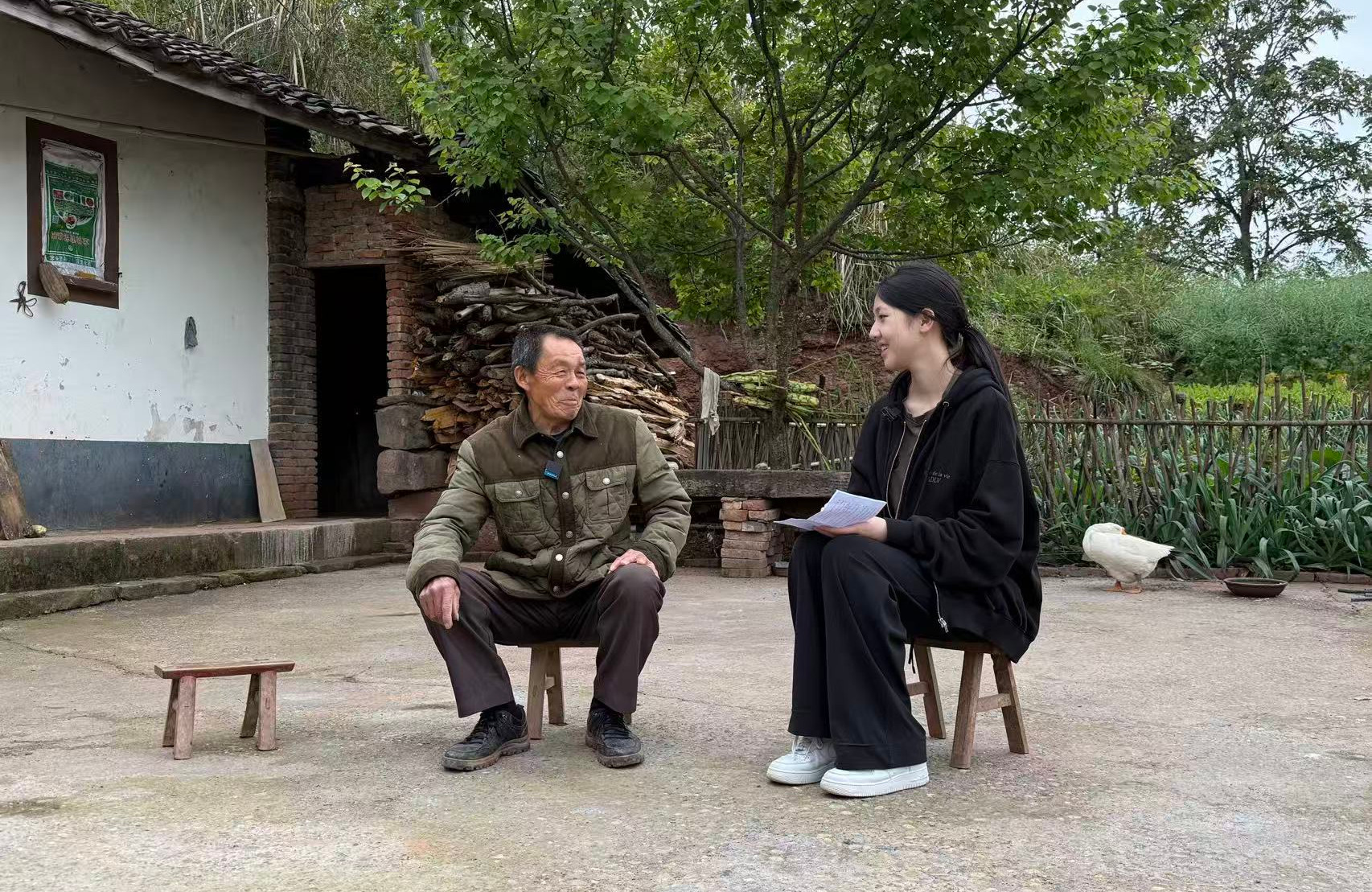
For our documentary The Pepper and the Keeper: Grains of Life, we spent time with Sichuan pepper farmers and recorded their daily lives, their relationships with the land, and their experiences of a countryside undergoing rapid change. We also interviewed rural residents about their families, income, children’s education, reasons for remaining in their villages, and hopes for the future.
Rather than reducing these conversations to statistics, we wanted each person to remain visible as an individual.
Their stories became the “leaves” on a pepper tree—
Hundreds together begin to tell the story of a changing countryside.

From Research to Action
Understanding a problem matters most when that understanding can return to the community.
Our work therefore extended beyond research and documentation.
We conducted household water screening for lead contamination and shared accessible materials explaining potential contamination sources, health risks, and practical ways to improve household water safety. We also explored new market opportunities for locally produced Sichuan pepper, including interviews with school cafeteria staff and analysis of consumer feedback.
At the policy level, findings from our environmental research and community work were integrated into the proposal “Environmental and Economic Sustainability Strategies for Sichuan Pepper Industry Development in Rural Areas,” offering recommendations for more sustainable agricultural and rural development.
Through the Global Guardians of Loneliness initiative, we also brought stories from these communities to wider audiences, connecting local experiences of aging, isolation, agriculture, and rural transformation with conversations beyond Sichuan.
These efforts took different forms—scientific research, interviews, water testing, documentaries, digital archives, market research, and policy recommendations—but they grew from the same question:
Who gets included when we talk about sustainability?


Sustainability Is About More Than What We Preserve
When we first entered the pepper fields, sustainability seemed like a question that could be approached largely through environmental science: soil health, agricultural inputs, crop productivity, and ecological resilience.
The longer we stayed, the less complete that definition became.
Sustainability is also about whether an aging farmer can continue earning a living from the land. It is about whether agricultural knowledge survives when younger generations leave. It is about whether environmental information is accessible to the people most affected by it. And it is about whether the experiences of communities undergoing change are preserved rather than disappearing unnoticed.
Scientific data remain essential. But data become more meaningful when they are placed alongside the knowledge of the people who live within the systems we are trying to understand.
The pepper fields taught us that environmental and human futures cannot easily be separated.
Perhaps sustainability is not only about asking how we can preserve the land.
It is also about asking what kind of future the people on that land will be able to build.


Comments